

If your child has recently received a dyslexia diagnosis—or even if you just suspect dyslexia—you are likely drowning in an alphabet soup of acronyms.
Two of the most common terms you will hear are IEP and 504 Plan.
Schools in the United States often use these terms casually, but for a parent, understanding the difference is critical. It is often the difference between your child getting permission to use an audiobook versus your child actually learning to read.
Here is a plain-English guide to the difference between an IEP and a 504 Plan, and how to know which one is right for your dyslexic learner.
The Short Answer: Instruction vs. Access
If you remember nothing else, remember this distinction:
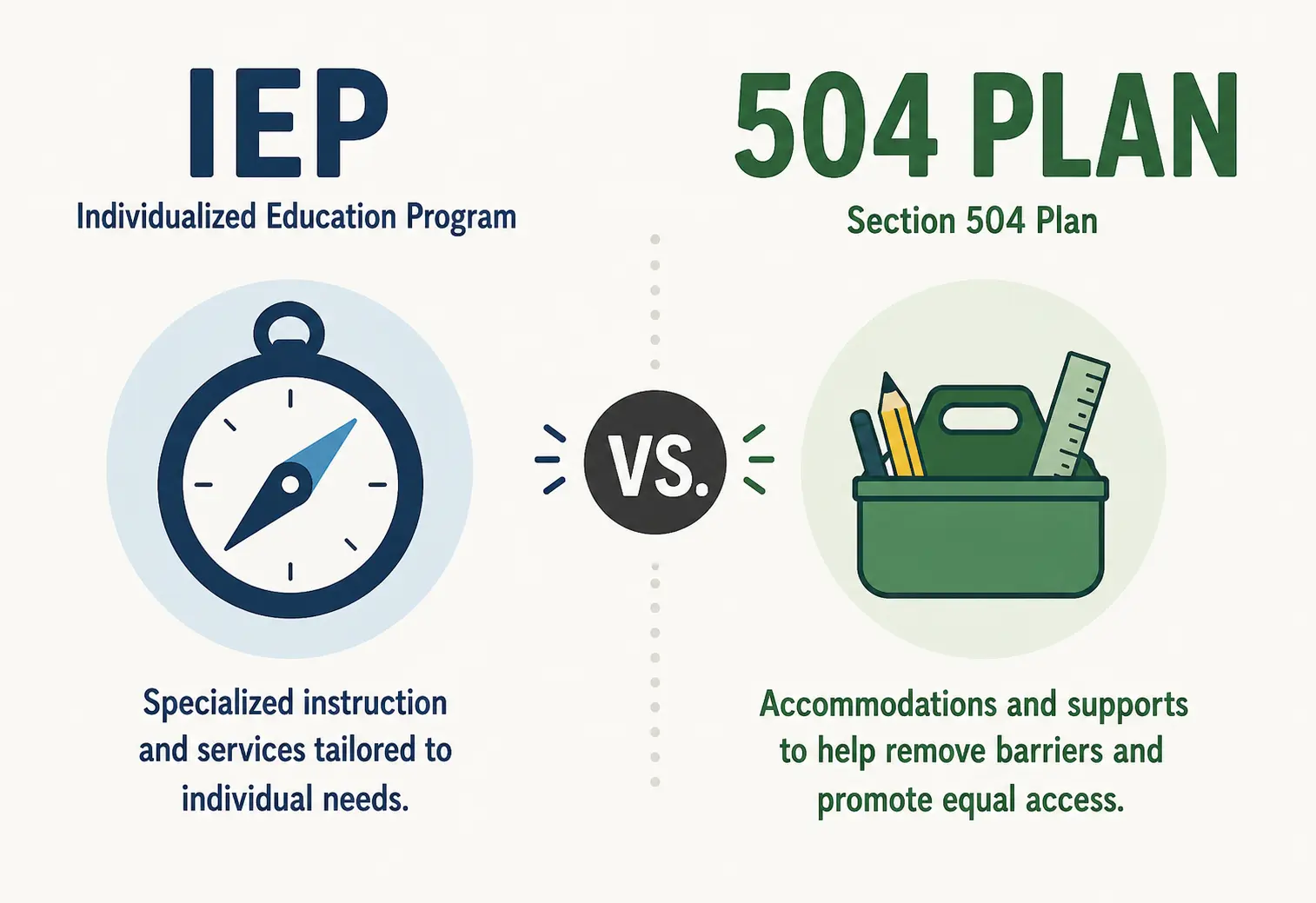
- An IEP (Individualized Education Program) provides specialized instruction. It creates a legal requirement for the school to teach your child differently to close a learning gap.
- A 504 Plan provides accommodations. It changes the environment so your child can access the same curriculum as their peers, but it does not typically change how they are taught.
Think of it like a ramp for access to a building vs. stairs.
- A 504 Plan builds the ramp so a student in a wheelchair can get into the building (Access).
- An IEP provides physical therapy to help the student strengthen their muscles (Remediation/Instruction) so they can use the stairs.
Deep Dive: The IEP (Individualized Education Program)
An IEP is authorized under the Individuals with Disabilities Education Act (IDEA). It is a detailed legal document tailored specifically to your child.
What it offers for dyslexia:
If your child is reading significantly below grade level, they likely need an IEP. An IEP allows for Specialized Academic Instruction. For a student with dyslexia, this should mean pull-out support with a reading specialist using a structured, evidence-based methodology (like Orton-Gillingham).
Key features of an IEP:
- Measurable Goals: The plan must state exactly what your child will achieve (e.g., “By June, [Child] will decode two-syllable words with 80% accuracy”).
- Progress Monitoring: The school must track data and report on whether your child is meeting those goals.
- Modifications: In addition to accommodations, an IEP can actually modify what the child is learning (e.g., shorter spelling lists or a different reading level).
Deep Dive: The 504 Plan
A 504 Plan falls under Section 504 of the Rehabilitation Act of 1973, which is a civil rights law. It is designed to prevent discrimination against people with disabilities.
What it offers for dyslexia:
A 504 plan is about “leveling the playing field.” It assumes your child can handle the general education curriculum if the barriers are removed. It does not usually provide a reading specialist or specialized tutoring.
Common 504 Accommodations for Dyslexia:
- Extended time on tests.
- Preferential seating (close to the teacher).
- Permission to use audiobooks or text-to-speech technology.
- Not being forced to read aloud in class.
- Use of a laptop for writing assignments.
Which One Does Your Child Need?
The answer depends on the severity of the reading gap and your child’s age. Sometimes your child might need both.
You likely need an IEP if:
- Your child cannot read grade-level text fluently.
- There are significant gaps in phonics, decoding, or spelling.
- Your child needs “remediation” (reteaching the basics of reading).
- Accommodations alone (like extra time) wouldn’t solve the problem because they simply cannot decode the words on the page.
You might only need a 504 Plan if:
- Your child has been remediated and reads relatively well, but does so slowly.
- They understand the material but need extra time to process it.
- They are “twice-exceptional” (gifted but dyslexic) and can compensate enough to keep up, but need technology (like speech-to-text) to demonstrate their intelligence without fatigue.
A Common Pitfall: The “Wait to Fail” Model
Parents should be aware that schools often prefer to offer a 504 Plan first because it requires fewer resources and less paperwork than an IEP.
You might hear a school say: “Let’s try a 504 Plan with extra time and see how he does.”
If your child has a fundamental issue with decoding words, extra time will not teach them to read. Giving a non-swimmer extra time in the pool does not help them swim; they need swimming lessons. If your child is struggling with the mechanics of reading, do not settle for a 504 Plan. Push for an evaluation for an IEP.
What If the School’s IEP Isn’t Working?
Even with an IEP, many public schools lack the resources or trained personnel to deliver true Orton-Gillingham instruction with the frequency required (2-3 times a week) to see real results.
This is where many parents turn to private intervention.
At The Reading Guru, we provide the specialized, high-intensity tutoring remediation that is often written into an IEP but rarely fully delivered in a busy classroom. We work alongside your school’s plan to ensure your child isn’t just “accommodated,” but is actually learning.
Confused about your child’s reading progress? Set up a free consultation to discuss whether your child needs remediation or just support, and how our specialized tutors can help close the gap.